publications
2026
-
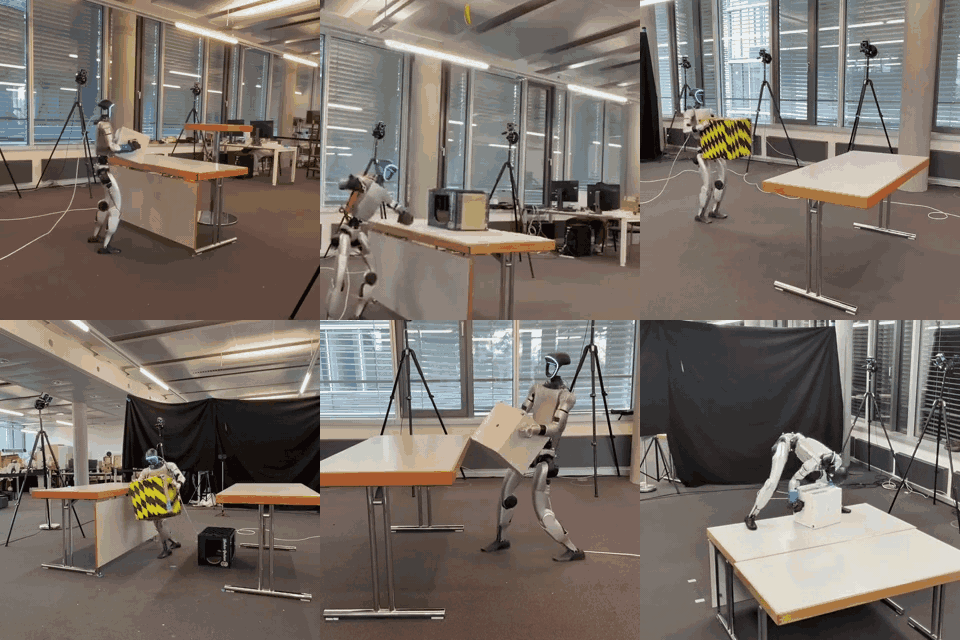 MotionDisco: Motion Discovery for Extreme Humanoid Loco-ManipulationIlyass Taouil*, Michal Ciebielski*, Shafeef Omar*, and 4 more authorsConference on Robot Learning (CoRL), 2026
We present MotionDisco, a framework that discovers contact-rich, long-horizon humanoid loco-manipulation motions from scratch, without relying on teleoperation or motion retargeting from human demonstrations. This is challenging because the space of possible contact interactions grows combinatorially with the task horizon and the number of objects in the scene. MotionDisco enables rapid discovery of novel motions by coupling a large language model (LLM) guided evolutionary search over sequences of interactions with an efficient sequential kinodynamic trajectory optimizer and pruning strategy. Through extensive ablation studies, we show that our LLM-guided search discovers successful whole-body trajectories across several challenging long-horizon tasks. Finally, by training reinforcement learning tracking policies on the discovered trajectories, we transfer the motions to a real humanoid robot. This is the first work to discover and deploy long-horizon humanoid loco-manipulation skills entirely through automated evolutionary search.
@article{taouil26motiondisco, title = {MotionDisco: Motion Discovery for Extreme Humanoid Loco-Manipulation}, author = {Taouil*, Ilyass and Ciebielski*, Michal and Omar*, Shafeef and Zhao, Haizhou and Dai, Angela and Johnson, Aaron M. and Khadiv, Majid}, journal = {Conference on Robot Learning (CoRL)}, year = {2026}, } -
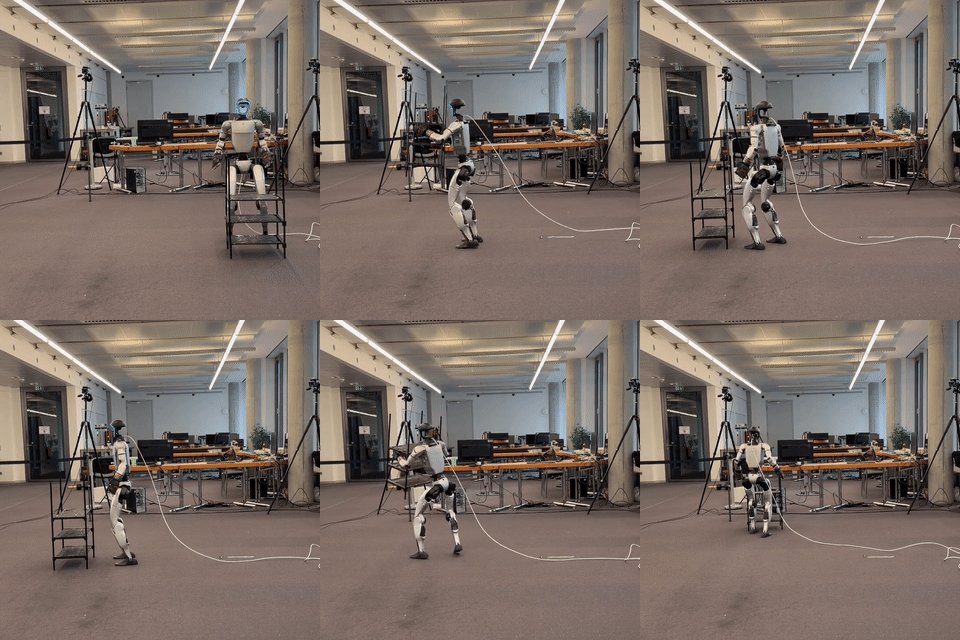 DynaRetarget: Dynamically-Feasible Retargeting using Sampling-Based Trajectory OptimizationVictor Dhedin*, Ilyass Taouil*, Shafeef Omar*, and 4 more authorsIEEE Robotics and Automation Letters, 2026
DynaRetarget: Dynamically-Feasible Retargeting using Sampling-Based Trajectory Optimization.
@article{dhedin26dynaretarget,
  title = {DynaRetarget: Dynamically-Feasible Retargeting using Sampling-Based Trajectory Optimization},
  author = {Dhedin*, Victor and Taouil*, Ilyass and Omar*, Shafeef and Yu, Dian and Tao, Kun and Dai, Angela and Khadiv, Majid},
  journal = {IEEE Robotics and Automation Letters},
  year = {2026},
}


2025
-
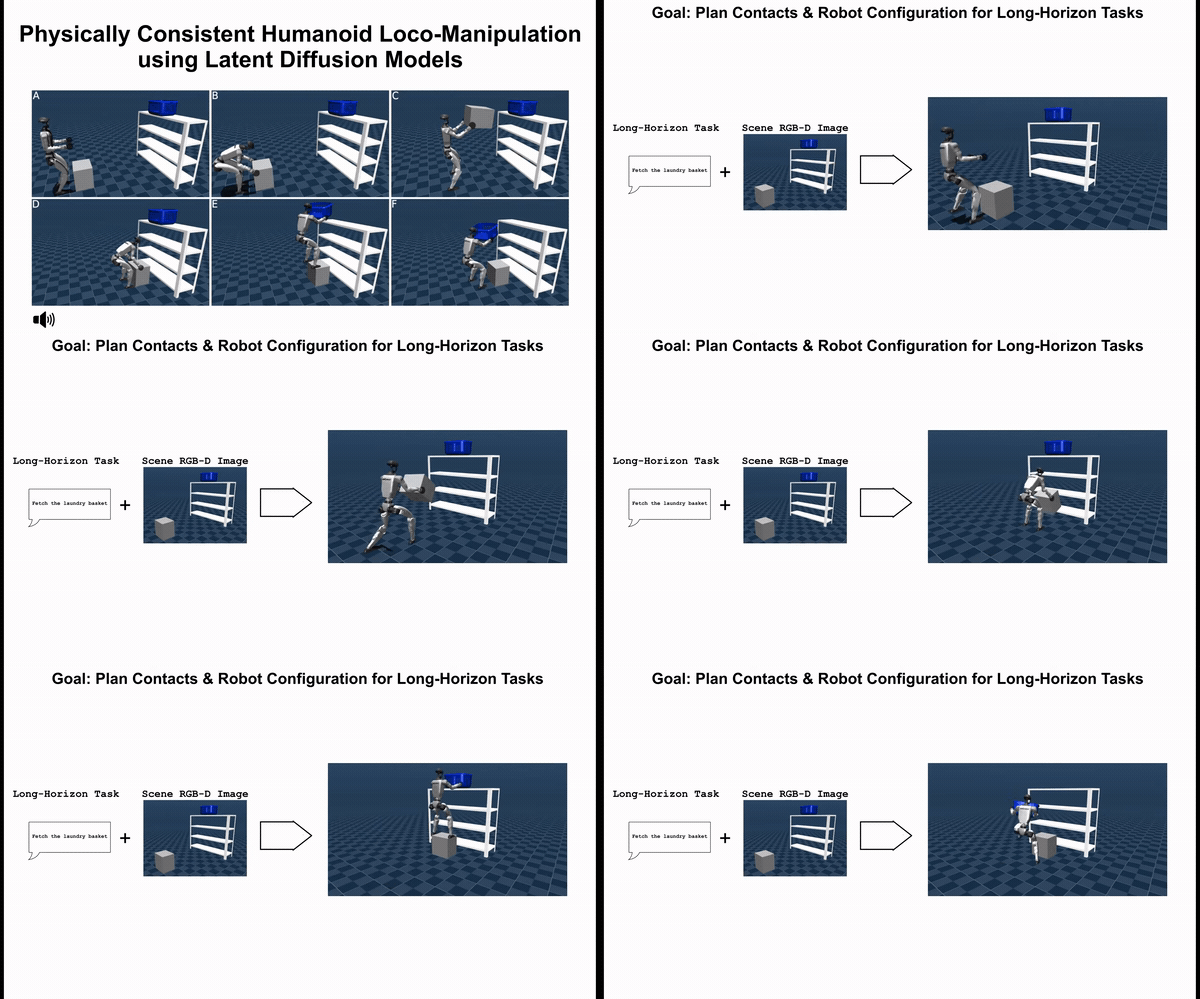 Physically Consistent Humanoid Loco-Manipulation using Latent Diffusion ModelsIlyass Taouil, Haizhou Zhao, Angela Dai, and 1 more authorIEEE-RAS International Conference on Humanoid Robots (Humanoids), 2025
This paper uses the capabilities of latent diffusion models (LDMs) to generate realistic RGB human-object interaction scenes to guide humanoid loco-manipulation planning. To do so, we extract from the generated images both the contact locations and robot configurations that are then used inside a whole-body trajectory optimization (TO) formulation to generate physically consistent trajectories for humanoids. We validate our full pipeline in simulation for different long-horizon loco-manipulation scenarios and perform an extensive analysis of the proposed contact and robot configuration extraction pipeline. Our results show that using the information extracted from LDMs, we can generate physically consistent trajectories that require long-horizon reasoning.
@article{taouil2025physically, title = {Physically Consistent Humanoid Loco-Manipulation using Latent Diffusion Models}, author = {Taouil, Ilyass and Zhao, Haizhou and Dai, Angela and Khadiv, Majid}, journal = {IEEE-RAS International Conference on Humanoid Robots (Humanoids)}, year = {2025}, } - Non-Gaited Legged Locomotion With Monte-Carlo Tree Search and Supervised LearningIlyass Taouil, Lorenzo Amatucci, Majid Khadiv, and 4 more authorsIEEE Robotics and Automation Letters, 2025
Legged robots are able to navigate complex terrains by continuously interacting with the environment through careful selection of contact sequences and timings. However, the combinatorial nature behind contact planning hinders the applicability of such optimization problems on hardware. In this work, we present a novel approach that optimizes gait sequences and respective timings for legged robots in the context of optimization-based controllers through the use of sampling-based methods and supervised learning techniques. We propose to bootstrap the search by learning an optimal value function in order to speed-up the gait planning procedure making it applicable in real-time. To validate our proposed method, we showcase its performance both in simulation and on hardware using a 22 kg electric quadruped robot. The method is assessed on different terrains, under external perturbations, and in comparison to a standard control approach where the gait sequence is fixed a priori.
@article{10806593,
  title = {Non-Gaited Legged Locomotion With Monte-Carlo Tree Search and Supervised Learning},
  author = {Taouil, Ilyass and Amatucci, Lorenzo and Khadiv, Majid and Dai, Angela and Barasuol, Victor and Turrisi, Giulio and Semini, Claudio},
  journal = {IEEE Robotics and Automation Letters},
  year = {2025},
  volume = {10},
  number = {2},
  pages = {1265-1272},
  keywords = {Planning;Optimization;Costs;Timing;Legged locomotion;Real-time systems;Quadrupedal robots;End effectors;Supervised learning;Hardware;Legged robots;gait adaptation;supervised learning},
  doi = {10.1109/LRA.2024.3519908},
}

2023
-
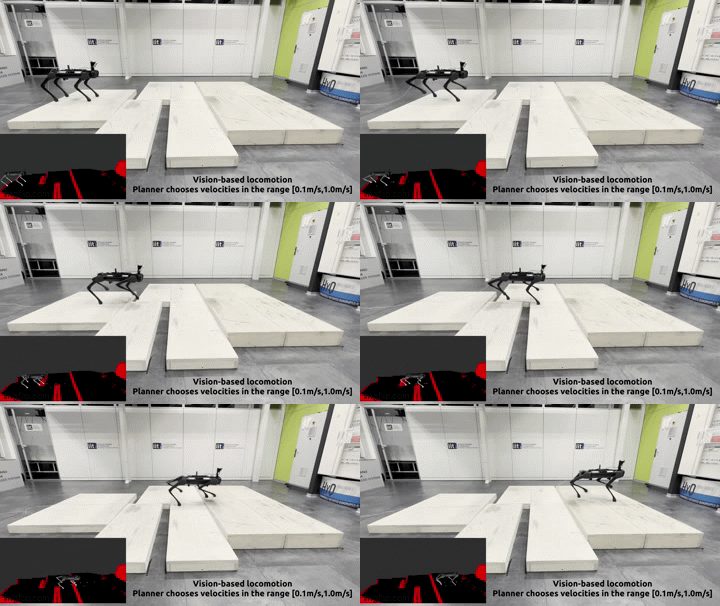 Quadrupedal Footstep Planning using Learned Motion Models of a Black-Box ControllerIlyass Taouil, Giulio Turrisi, Daniel Schleich, and 3 more authorsIEEE/RSJ International Conference on Intelligent Robots and Systems (IROS), 2023
Legged robots are increasingly entering new domains and applications, including search and rescue, inspection, and logistics. However, for such a systems to be valuable in real-world scenarios, they must be able to autonomously and robustly navigate irregular terrains. In many cases, robots that are sold on the market do not provide such abilities, being able to perform only blind locomotion. Furthermore, their controller cannot be easily modified by the end-user, requiring a new and time-consuming control synthesis. In this work, we present a fast local motion planning pipeline that extends the capabilities of a black-box walking controller that is only able to track high-level reference velocities. More precisely, we learn a set of motion models for such a controller that maps high-level velocity commands to Center of Mass (CoM) and footstep motions. We then integrate these models with a variant of the A* algorithm to plan the CoM trajectory, footstep sequences, and corresponding high-level velocity commands based on visual information, allowing the quadruped to safely traverse irregular terrains at demand.
@article{taouil2023quadrupedal,
  title = {Quadrupedal Footstep Planning using Learned Motion Models of a Black-Box Controller},
  author = {Taouil, Ilyass and Turrisi, Giulio and Schleich, Daniel and Barasuol, Victor and Semini, Claudio and Behnke, Sven},
  journal = {IEEE/RSJ International Conference on Intelligent Robots and Systems (IROS)},
  year = {2023},
}
